
If nutrition labels make your eyes glaze over, you’re not the only one. This guide shows how to read sugar on labels in a simple, repeatable way—so you can compare products without stress or perfection. Think “better default choices,” not strict rules.
Written by: HWVibes Editorial Team • Last updated: September 2026
Expert reviewed
Last reviewed: 24 September 2026
Dr. Hena A. Ansari (MBBS, MD) reviewed this page to keep the label-reading guidance clear and non-alarming,
avoid diet prescriptions, and ensure common label terms are explained in a responsible, consumer-friendly way.
View full profile →
Reminder: This page is general education and does not replace medical care.
Key takeaways (read this first)
- Serving size is the #1 reason sugar numbers feel confusing.
- If listed, added sugars helps you compare brands faster than total sugar alone.
- The ingredients list is the fastest truth-check (especially where added sugar isn’t listed).
- Labels work best for comparison, not perfection.
- Quick start (60-second method)
- What to check first (in order)
- Serving size: the #1 “gotcha”
- Total sugars vs added sugars
- Added sugars % Daily Value and teaspoons
- Ingredients list: the fastest clue
- Common names for sugar
- Label claims (plain English)
- How to compare two products quickly
- Common traps
- Questions people ask
- References
- Disclaimer
- Related guides
Quick start: how to read sugar on labels in 60 seconds
- Serving size
- Added sugars (if listed)
- Ingredients list (look for multiple sweeteners)
- Compare similar products
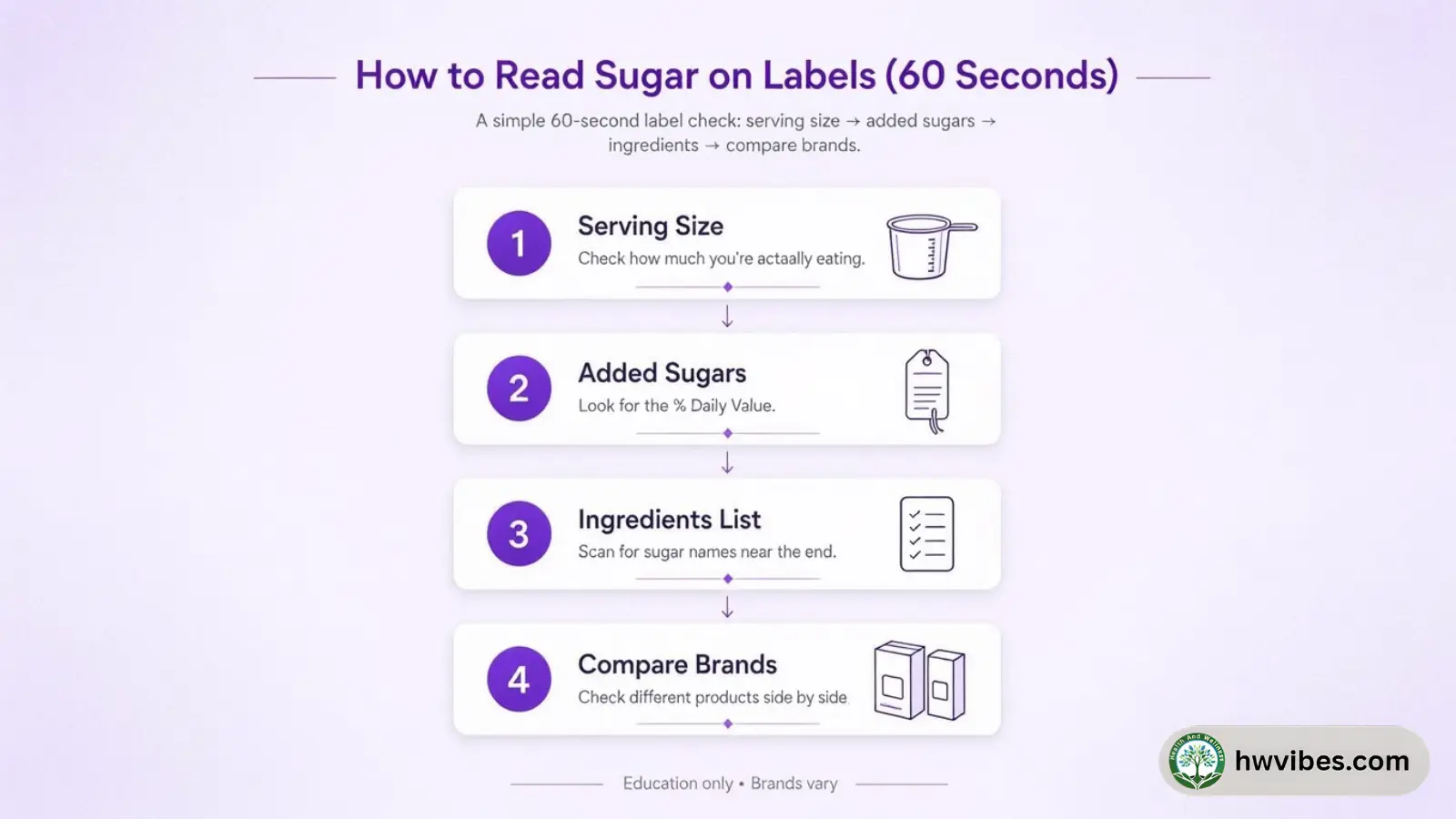
If label claims confuse you, see: No Added Sugar vs Unsweetened vs Sugar-Free.
What to check first (in order)
1) Serving size
Serving size is the most common reason labels feel misleading.
2) Added sugars (when available)
In some countries (including the U.S.), labels can include “added sugars.” Official context: Mayo Clinic.
3) Ingredients list
Ingredients are listed by weight. Multiple sugar names often means the product is built to taste sweeter.
4) Compare similar products
Compare two cereals, two yogurts, two sauces—labels are best for comparison.
Serving size: the #1 “gotcha”
Most sugar numbers are per serving. Many packages contain more than one serving—even when they look like one portion.
Total sugars vs added sugars (simple explanation)
- Total sugars: naturally occurring + added sugars
- Added sugars: sweeteners added during processing (when listed)
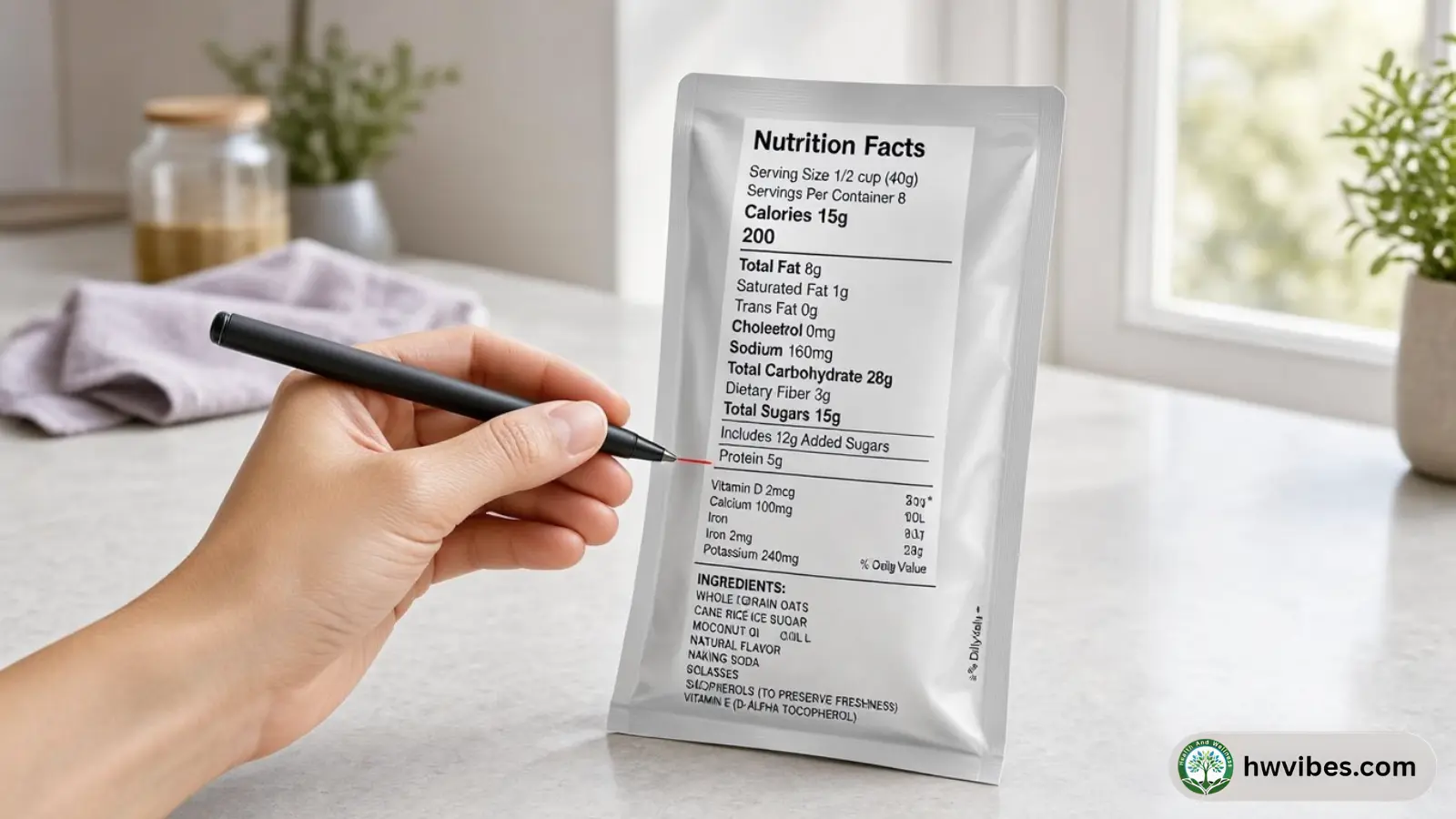
If your label doesn’t list added sugars, rely more on the ingredients list + comparison shopping.
Added sugars % Daily Value and grams to teaspoons
On the US Nutrition Facts label, “Includes Xg Added Sugars” also shows a % Daily Value (%DV). The Daily Value for added sugars is 50 g a day on a 2,000-calorie diet, and the goal is to stay below it (FDA).
- 5% DV or less per serving (2.5 g or less) is considered low.
- 20% DV or more per serving (10 g or more) is considered high.
To picture grams, use this shortcut: about 4 grams of sugar = 1 teaspoon. A drink with 40 g of added sugar contains roughly 10 teaspoons.
| Added sugars on label | Roughly | % Daily Value |
|---|---|---|
| 4 g | 1 teaspoon | 8% |
| 10 g | 2½ teaspoons | 20% (high) |
| 25 g | 6 teaspoons | 50% |
| 39 g (e.g. a 12 oz regular cola; brands vary) | about 10 teaspoons | 78% |
A typical 12-ounce regular cola may contain roughly the mid-30s to around 40 g of sugar, depending on the brand, so check the label of the specific product.
Try it: type the added sugars from any label into the converter below.
Added-sugar converter
Type the added sugars from a nutrition label to see it in teaspoons and against daily limits.
Uses 4 g of sugar ≈ 1 teaspoon. Daily Value from the US FDA; limits from the American Heart Association. General education only, not medical advice.
For a stricter personal target, the American Heart Association suggests no more than about 25 g of added sugar a day for most women and 36 g for most men.
Ingredients list: the fastest clue
- Multiple sweeteners (sugar + syrup + concentrate)
- Sweeteners near the top of the list
- “Healthy-sounding” sweeteners (still sweeteners when added)
Common names for sugar
| Type | Examples |
|---|---|
| Basic sugars | Sugar, cane sugar, brown sugar |
| Syrups | Corn syrup, high fructose corn syrup, rice syrup |
| “Natural” sweeteners | Honey, agave, maple syrup |
| Scientific-sounding | Dextrose, maltose, sucrose, glucose, fructose |
| Fruit-based sweeteners | Fruit juice concentrate |
Label claims (plain English)
No added sugar
No sweeteners added during processing—but can still contain naturally occurring sugars.
Unsweetened
Often means no sweetener was added—still confirm ingredients.
Reduced sugar
Often means less than the original version—not necessarily low sugar.
Full breakdown: No Added Sugar vs Unsweetened vs Sugar-Free.
How to compare two products quickly
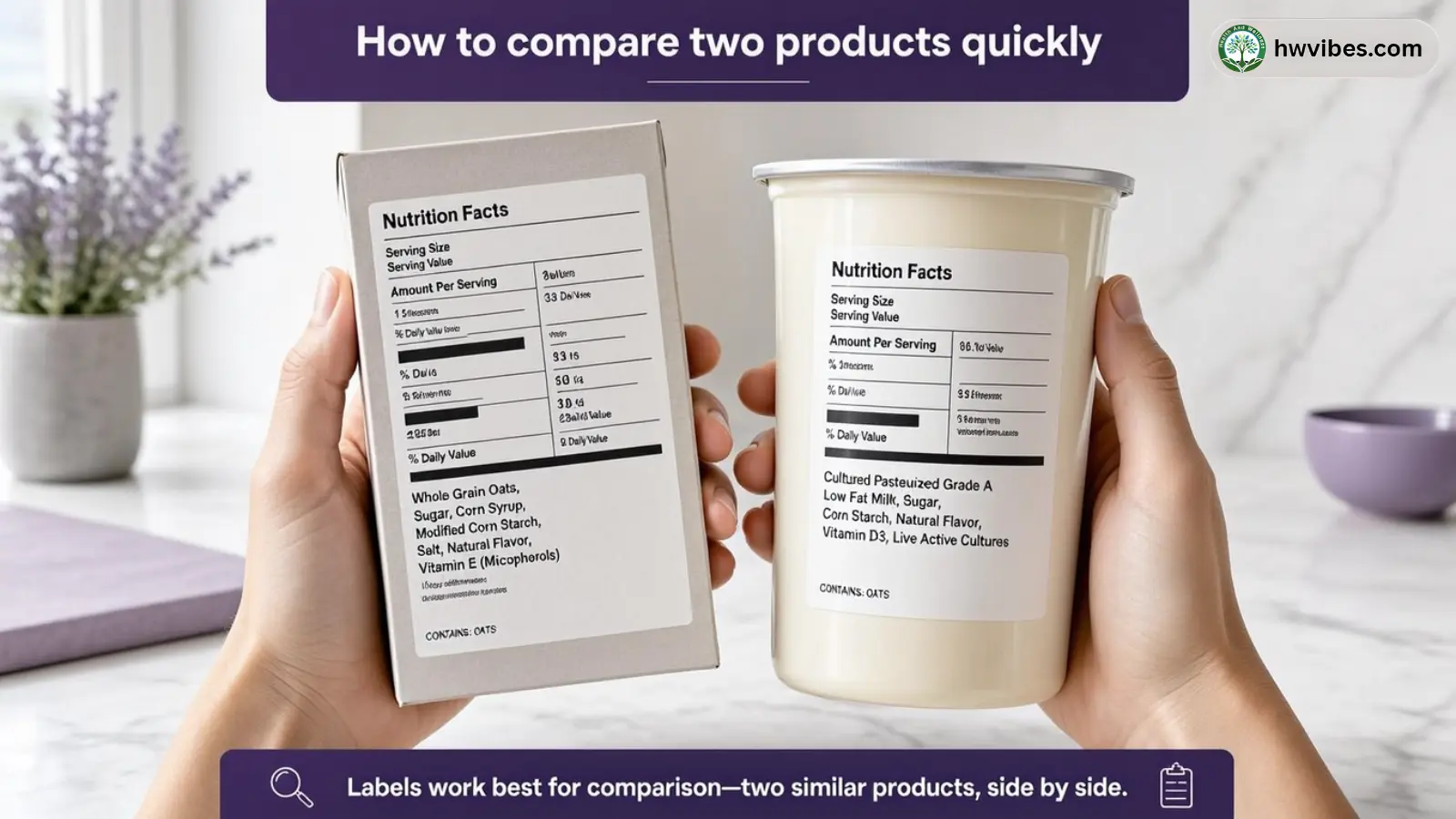
- Compare the same category.
- Check serving size.
- Check added sugars (if listed) and total sugars.
- Scan ingredients.
- Pick the better default.
Common traps
Trap: tiny serving sizes
If you eat 2–3 servings, the sugar number changes.
Trap: “no added sugar” = “low sugar”
Not always—naturally sweet foods can still have high total sugar.
Trap: marketing words
“Natural” and “real fruit” don’t guarantee low sugar. Confirm with the label.
Questions people ask
What’s the difference between total sugars and added sugars?
Total sugars include naturally occurring sugars plus added sugars. Added sugars are sweeteners added during processing (when listed).
What are hidden names for sugar?
Common names include sugar, syrups, honey, agave, and juice concentrates. The ingredients list is the fastest place to spot them.
Is no added sugar the same as sugar-free?
Not necessarily. “No added sugar” can still contain naturally occurring sugars. “Sugar-free” is a different claim.
How many grams of sugar are in a teaspoon?
About 4 grams. To convert the grams on a label into teaspoons, divide by 4. For example, 20 g of added sugar is about 5 teaspoons.
What is a high amount of added sugar on a label?
The FDA considers 20% Daily Value or more per serving high, which is 10 g of added sugar or more. 5% DV or less (2.5 g or less) is low.
How much added sugar per day is OK?
The Daily Value on US labels is 50 g of added sugar a day for a 2,000-calorie diet. The American Heart Association suggests a lower limit of about 25 g for most women and 36 g for most men.
References
Disclaimer
This page is for general education only. It does not provide medical advice, diagnosis, or treatment. If you have a medical condition, are pregnant, take medication, have allergies, or symptoms that worry you, consult a qualified healthcare professional.
Full disclaimer: https://hwvibes.com/disclaimer/
Medical disclaimer: HWVibes provides general health information for educational purposes only. It is not a substitute for professional medical advice, diagnosis or treatment, and reading it does not create a doctor–patient relationship. Always ask your doctor or another qualified health provider about any medical question or before trying anything described here, and never ignore professional advice or delay seeking it because of something you read on this site. Read the full medical disclaimer.
Spotted something that looks wrong or out of date? Tell us and our editors will check it.