
If stress makes you want sweets, you’re not alone—and you’re not “undisciplined.” The stress and sugar cravings connection is common: when life feels heavy, the brain often looks for quick comfort. This guide explains why that happens and gives 10 calming alternatives you can try (no strict rules, no guilt).
Written by: HWVibes Editorial Team • Last updated: September 2026
Expert reviewed
Last reviewed: 24 September 2026
Dr. Hena A. Ansari (MBBS, MD) reviewed this page to ensure the stress/cravings discussion stays education-only,
avoids shaming language, and keeps suggestions general, low-risk, and non-prescriptive.
View full profile →
Reminder: This page is general education and does not replace medical care.
Key takeaways (quick)
- Stress cravings are often about comfort + relief, not “lack of discipline.”
- Cravings often follow a loop: stress → quick comfort → short relief → cravings return.
- You don’t need strict bans. Many people do better by adding alternatives that interrupt autopilot.
- If cravings get louder at night, poor sleep may contribute for some people (see: Sleep and Sugar Cravings).
- Quick answer
- Why stress can trigger sugar cravings
- Cortisol and sugar cravings (research)
- Mini check: is this stress or hunger?
- Common stress + sugar patterns
- 10 calming alternatives (non-food)
- What to eat when stressed and craving sugar
- How to use this list in real life
- When to get help
- Questions people ask
- References
- Disclaimer
- Related guides (topic cluster)
Quick answer
Stress can make sugar cravings feel stronger because sweet foods are a quick reward: easy, comforting, familiar. When you’re stressed, tired, or emotionally drained, that quick reward can feel extra tempting.
If your cravings spike mainly when you’re tired, pair this with: Sleep and Sugar Cravings.
Why stress can trigger sugar cravings
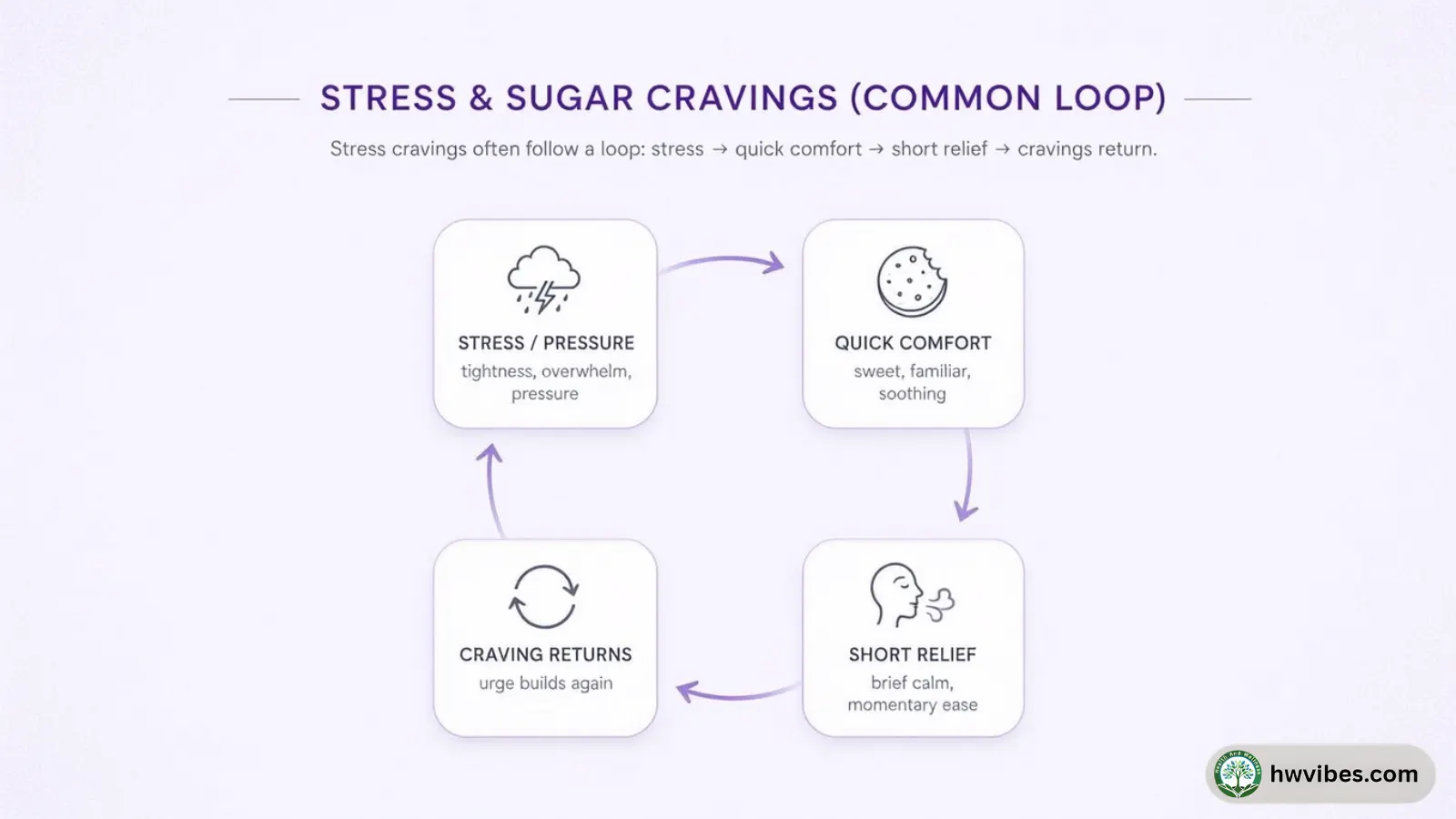
You don’t need to “fix your personality” to improve stress cravings—understanding the pattern is the first step. A general overview of how stress affects the body is covered by the American Psychological Association (APA).
1) The brain looks for fast relief
Under stress, quick comfort is attractive. Sweet foods can feel like a fast mood shift—even if it doesn’t last long.
2) Stress reduces “decision energy”
After a heavy day, planning meals and making patient choices gets harder. Convenience wins.
3) Stress and sleep often travel together
Stress can disrupt sleep, and poor sleep can make cravings louder the next day. See the Sleep Foundation for sleep basics.
4) Habit loops become automatic
Over time, “stress → sweet snack” can become your default. The good news: habits can be reshaped with small, repeatable steps.
Cortisol and sugar cravings: what the research says
When you are stressed, your body releases cortisol, a hormone that helps mobilise energy. Stress can influence appetite and food choice. In a small laboratory study of 59 women, participants with stronger cortisol responses to stress consumed more calories after the stress task and consumed more sweet food than lower responders (Epel et al., 2001). This association does not mean cortisol has the same effect in everyone.
Stress-related eating can also become habitual: if a person repeatedly pairs a particular food with stressful situations, the food may become part of an automatic coping routine. That is one reason stress cravings can feel automatic, and it says nothing bad about willpower.
Mini check: is this stress or hunger?
Not a diagnosis. Just a fast self-check many people find helpful.
- If you’re hungry: you may need actual food (something more filling than “quick sugar”).
- If you’re tired: cravings often get louder—sleep may help more than willpower.
- If you’re stressed or emotionally overloaded: try a calming alternative first, then decide.
- If you’re lonely: connection can be more effective than a snack.
If you want snack ideas that feel steadier (without strict dieting), see: Balanced Snacks for Sugar Cravings.
Common stress + sugar patterns

See if any of these feel familiar:
- Afternoon slump + stress snack: “I need a push to finish the day.”
- Evening unwind craving: once you finally stop, the brain asks for comfort.
- Reward eating: “I survived today, I deserve this.” (Very human.)
- Busy day, missed meals: long gaps can make quick calories feel urgent.
- Stress + sugary drinks: sweet coffee or soda becomes a default ritual.
10 calming alternatives (non-food) you can try instead
These are optional ideas—not rules. The goal isn’t to “never eat sugar.” The goal is to give your brain another way to downshift when stress is high. Pick 1–2 that feel realistic.
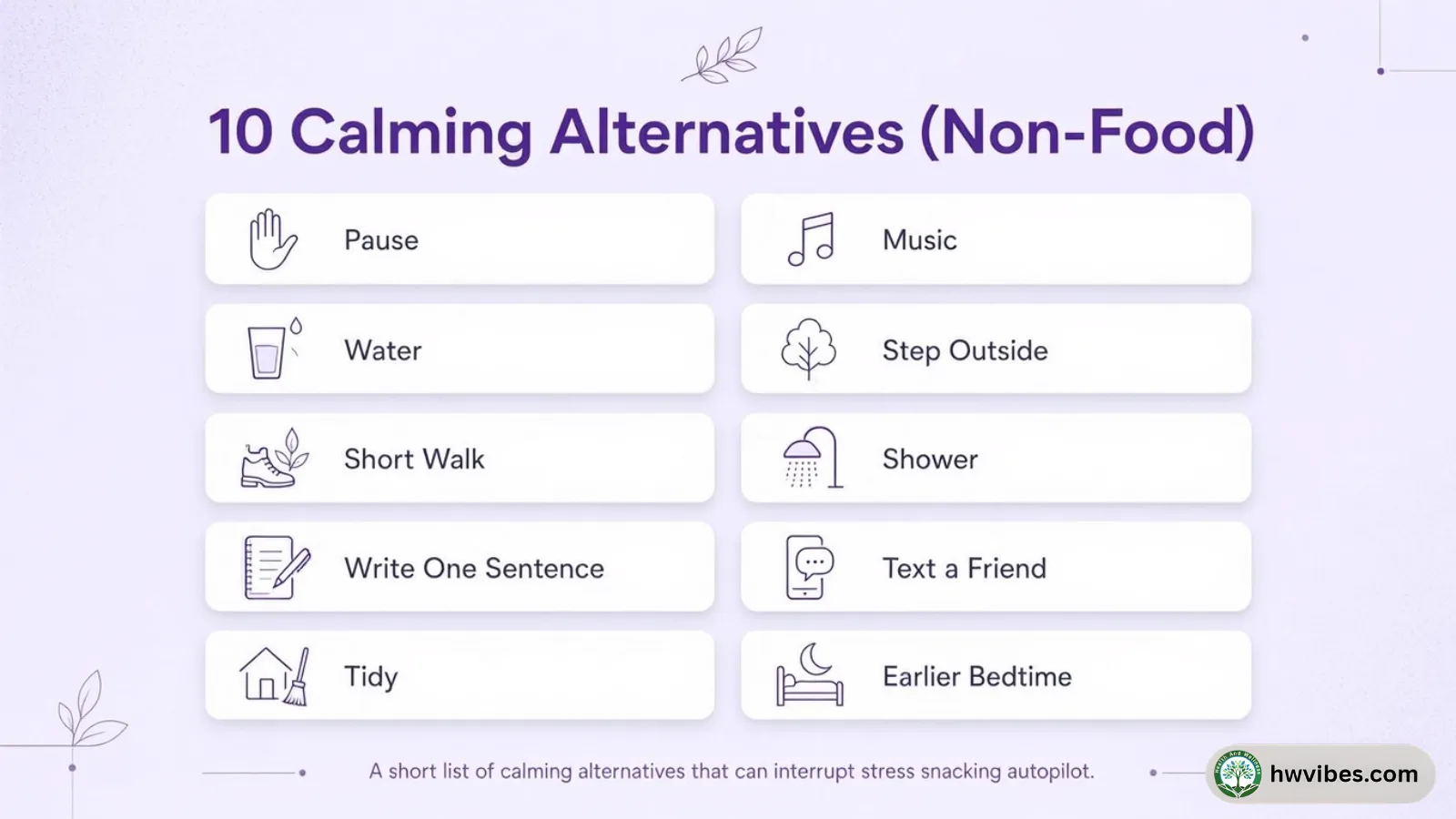
1) The 60-second pause
Before grabbing something sweet, pause for one minute and ask: “Am I hungry, tired, stressed, or bored?”
2) Water + a change of room
A glass of water and moving to a different room can interrupt autopilot. (If sugary drinks are part of your pattern, see: CDC guidance.)
3) A short walk (even 5 minutes)
Gentle movement can help some people feel more balanced. General activity benefits: American Heart Association.
4) Write one sentence
Open Notes and write: “Right now I feel ___ because ___.” This can reduce the pressure to “eat the feeling.”
5) Do a tiny tidy (3 minutes)
Set a timer and tidy one small area (desk/counter). Small wins can change your mood fast.
6) Music reset
Play one calming or uplifting song. One track is enough.
7) Step outside (light + air)
Fresh air + different lighting can help you feel less stuck in the stress loop.
8) Warm shower or face wash
A sensory reset can help some people unwind without reaching for food.
9) Text or voice note to someone safe
Connection reduces stress. A quick “rough day” message can help more than you’d expect.
10) Choose sleep as the “treat”
If it’s late and cravings hit, sometimes the best move is an earlier night. See: Sleep and Sugar Cravings.
What to eat when you are stressed and craving sugar
Sometimes a non-food reset is enough. Other times you are actually hungry, or you want something sweet, and that is fine. These examples combine sweetness with protein, fat or fiber and may be more filling than sweets eaten alone:
- Plain Greek yogurt with berries and a drizzle of honey
- An apple or pear with peanut butter
- A small square or two of dark chocolate with a handful of nuts
- Dates stuffed with nut butter (sweet, but with some fat and fiber)
- A warm drink such as cinnamon tea or warm milk, which can feel soothing in itself
- A proper meal if it has been more than 4–5 hours since you ate
More ideas: Healthy snacks for sugar cravings (20 ideas).
How to use this list in real life
- Pick your top 2 alternatives.
- Use them at your usual craving time (after work / after dinner / late-night scroll).
- Keep it small (1 minute, 1 song, 1 short walk).
- Track patterns, not calories: stress level, sleep, skipped meals, and cravings timing.
If you want a label-based approach for cutting hidden sugar without perfection, start here: How to Read Sugar on Labels.
When to get help
If stress eating feels frequent, distressing, or out of control—or if you feel stuck in a cycle you can’t break—consider speaking with a qualified professional. Support can be practical and non-judgmental.
If you suspect anxiety, depression, chronic stress, or disordered eating patterns, professional support can be especially helpful. You don’t have to figure it out alone.
Questions people ask
Why do I crave sugar when I’m stressed?
Many people reach for quick comfort under stress. Sweet foods are a fast reward and can become a habit loop over time.
Is stress eating the same as emotional eating?
They overlap. Stress eating is often one form of emotional eating, where food is used for comfort rather than hunger.
How do I stop stress cravings without banning sugar?
Many people do better by adding alternatives (pauses, movement, sleep, stress tools) rather than using strict “never” rules.
Why do I crave sugar more at night when stressed?
Night cravings are common when tired and stressed. The brain looks for comfort, and decision energy is lower. See also: Sleep and Sugar Cravings.
What if I try alternatives and still want sweets?
That’s normal. The goal is not to “erase” cravings—it’s to reduce autopilot and make choices calmer.
Does cortisol make you crave sugar?
Stress can influence appetite and food choice. In a small laboratory study of 59 women, those with stronger cortisol responses to stress ate more calories and more sweet food afterwards than lower responders. This is an association in one small group and does not mean cortisol has the same effect in everyone.
What should I eat when I am stressed and want sugar?
Pair something sweet with protein, fat or fiber: yogurt with berries, fruit with nut butter, or a little dark chocolate with nuts. If you have not eaten for several hours, a proper meal usually works better than a snack.
References
- American Psychological Association (APA): Stress and the body
- Sleep Foundation: Sleep hygiene
- CDC: Drink water instead of sugary drinks
- American Heart Association: Benefits of physical activity
- Epel E, et al. Stress may add bite to appetite in women: a laboratory study of stress-induced cortisol and eating behavior. Psychoneuroendocrinology, 2001.
Disclaimer
This page is for general education only. It does not provide medical advice, diagnosis, or treatment. Do not use it to make personal health decisions. If you have a medical condition, are pregnant, take medication, have allergies, or symptoms that worry you, consult a qualified healthcare professional.
Read the full site disclaimer: https://hwvibes.com/disclaimer/
Medical disclaimer: HWVibes provides general health information for educational purposes only. It is not a substitute for professional medical advice, diagnosis or treatment, and reading it does not create a doctor–patient relationship. Always ask your doctor or another qualified health provider about any medical question or before trying anything described here, and never ignore professional advice or delay seeking it because of something you read on this site. Read the full medical disclaimer.
Spotted something that looks wrong or out of date? Tell us and our editors will check it.